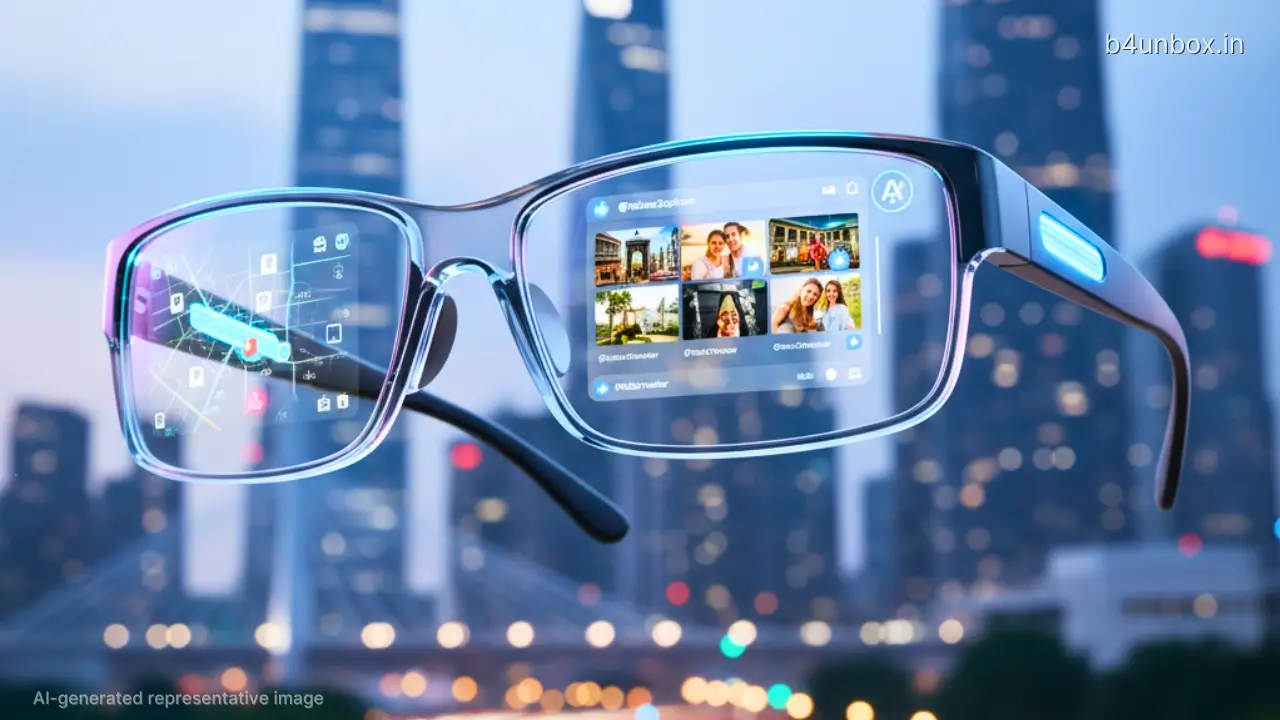
AI glasses are getting more powerful every month. They can now translate live, detect objects, show AR overlays, and even search instantly just by looking at something.
Still, most users see them as an “extra gadget” — not a full replacement for their phones.
In India, the smartphone is not just a screen. It’s a habit, a comfort zone, and part of our thinking pattern.
So, replacing it is not only about technology — it’s also about human behaviour change.
Why 2028 Looks Like a Turning Point for AI Glasses
Experts say three major technologies will mature together by 2028:
Key Technologies Maturing by 2028
- Near-field AR visual projection
- Low-power AI processing (on-device inference)
- Micro-gesture recognition (control by hand or eye)
That year could become the bridge between “experiment” and “daily use.”In India, we usually follow a slow adoption curve — first we observe, then try, and finally the trend becomes mass.
AI glasses are walking that same path right now.
Which Companies Have Launched AI Glasses in India and Globally?
Here are the main players working on AI glasses around the world and in India:
Global & Indian AI Glasses Brands
- Meta Platforms (Ray-Ban Meta) – Meta has already launched smart AI glasses globally with Ray-Ban. They can record, stream, and answer AI questions directly.
- Lenskart (India) – Under the brand “B by Lenskart,” the company is developing Made-in-India AI-powered glasses with voice assistant and UPI-payment features.
- Lenovo – Introduced Lenovo AI Glasses V1, focused on work and productivity use-cases.
- Baidu (China) – Its Xiaodu Pro smart glasses offer real-time translation and object recognition.
- Xreal / Oppo / Xiaomi – Working on AR+AI integrated eyewear prototypes aimed at 2026–2028 consumer launches.
So yes, the AI glasses race has already started — and India is part of it.
The Real Barriers: Comfort and Compatibility
For AI glasses to replace smartphones, they must make four everyday tasks feel natural:
Everyday Usage Challenges
- Reading and replying to WhatsApp messages smoothly.
- Using maps and navigation without looking awkward.
- Making UPI payments easily through voice or gesture.
- Maintaining natural eye contact — no social weirdness.
Right now, people still feel self-conscious wearing tech on their faces.This “emotional comfort gap” is one of the biggest barriers to mass adoption.
Battery Limitations — Why the Smartphone Still Matters
AI glasses are tiny, so they can’t fit a big battery.
A normal phone has a 4,500–5,000 mAh cell, but glasses can’t.Because of this, most AI glasses depend on a phone connection or external battery support.
Smartphone as Compute Hub
Even in 2028, smartphones will likely remain the main compute hub, with glasses acting as the secondary screen.
Eye Safety — Still a Concern
Labs like MIT, Stanford, and Berkeley have raised early observations about long-term use of AR/AI glasses:
Health & Eye Effects
Long AR focus can cause eye-muscle fatigue.
Bright displays may create retina stress.
Fast switching between real and virtual layers increases mental load.
Long hours can cause eye dryness.
Medical Safety Outlook
So, “continuous wear” is not yet considered medically ideal.Safety and comfort standards still need time to evolve.
India’s Reality — Not Replacement, But Hybrid Future
By 2028, AI glasses may replace phones for some users, but not for everyone.India’s adoption pattern could look like this:
Adoption by User Category
Rich users – Lifestyle and show-off adoption
Upper-middle class – Mixing phone + glasses usage
Middle class – Trial and curiosity use
Lower income – Aspiration only, not actual use
So yes, smartphones won’t disappear. They’ll simply transform — becoming the processing core behind smaller smart devices like AI glasses or wearables.
Possible Benefits — and the Human Side
Interestingly, AI glasses could also reduce scrolling addiction.Since they work on quick, purpose-based triggers — not endless scrolling — users might spend less random time online.
That’s a small but meaningful change for mental well-being.
Still, people need time to accept talking or gesturing in public while wearing glasses.Tech can advance fast — but human comfort moves slow.
Final Thought
AI glasses represent the next step in personal tech — but they’re not here to replace your phone yet.
They’re here to change how we interact with technology, one gesture and one glance at a time.
For India, the future looks hybrid — smartphones at the core, and AI glasses as the smart companion on top.
FAQs
A: Not easily. Maybe a few entry-level models will come, but most will stay premium.
A: Partly, yes. But for full functions like data processing or heavy apps, the phone will still be needed.
A: Not yet fully. Long wear can cause dryness and eye strain.
A: To some extent, yes. Because the design encourages shorter, meaningful use.
A: Not before 2028. They’ll first remain a style and curiosity product.
