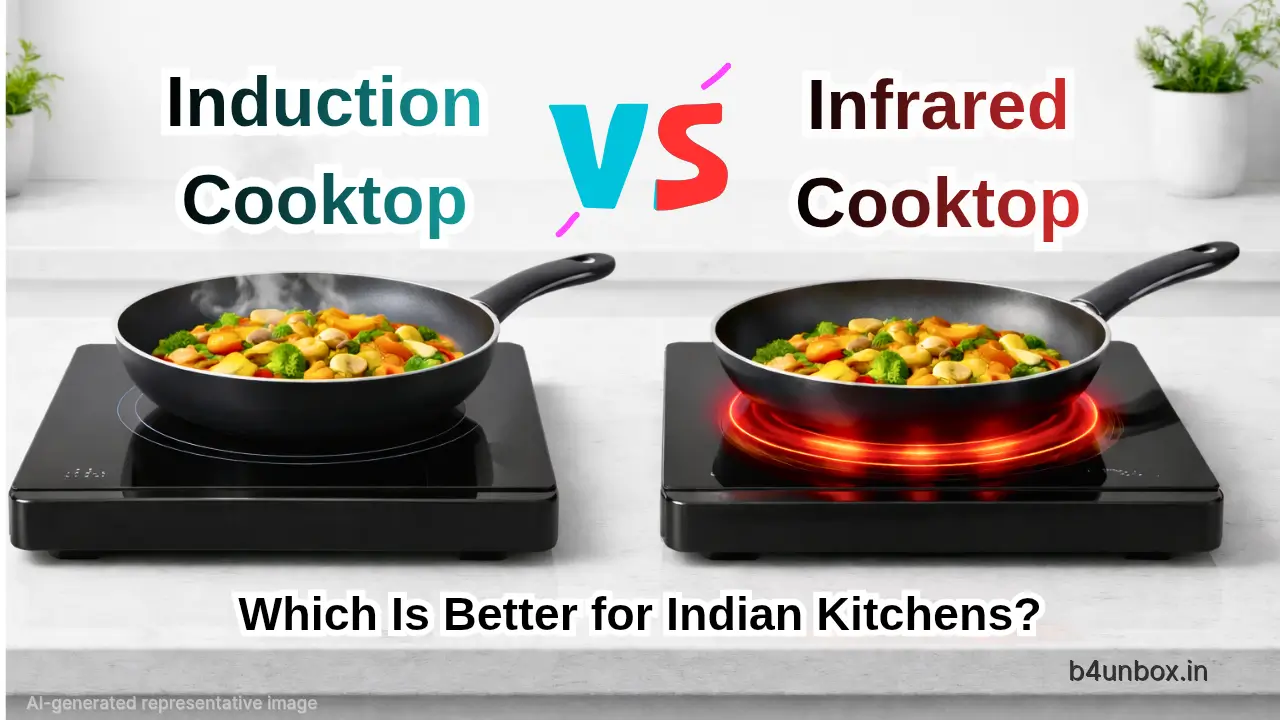
Various types of electric cooktops are becoming increasingly common in many Indian households. Furthermore, students living in hostels, small families, and individuals facing shortages of gas cylinders often seek alternatives to traditional gas stoves.
If you want faster cooking, lower electricity bills, and better safety, an induction cooktop is the better option. If you want support for aluminium, glass, and almost all utensils, then an infrared cooktop is a better choice.
When searching online, most people encounter three primary options: electric coil stoves, induction cooktops, and infrared cooktops. However, in this article, we will focus specifically on induction cooktops and infrared cooktops.
At first glance, both induction and infrared cooktops appear nearly identical. They typically feature a flat glass surface, digital controls, and a compact design. Consequently, many buyers assume that both technologies operate in the same manner.
The reality, however, is that induction and infrared cooktops utilize entirely different heating mechanisms; understanding this distinction will help you make a more informed purchasing decision.
The Real-Life Problem Many Users Face
Imagine someone purchasing an electric cooktop for the very first time.
They search online and come across two appliances that look identical. One is an induction cooktop, and the other is an infrared stove. Both claim to offer rapid cooking, energy efficiency, and a modern design.
This is precisely where the confusion begins:
Some users purchase an induction cooktop, only to realize later that their old aluminum cookware does not work on it. This is because induction stoves require magnetic cookware to function; since aluminum is non-magnetic, heat is not generated within it. Furthermore, cookware with a concave or uneven bottom does not cook food effectively.
Conversely, some individuals purchase an infrared cooktop with the expectation of rapid cooking, only to discover that it takes a significantly longer time to heat up.
This confusion typically arises because people tend to focus on the appliance’s design rather than the underlying heat-generating technology. Understanding how these cooktops generate heat makes the decision-making process much simpler.
Why This Confusion Happens
The biggest reason for confusion is appearance.
Both induction and infrared cooktops often have:
- A black glass surface
- Digital touch or button controls
- Similar size and shape
- Compact countertop design
Due to this similarity, many people feel that these are merely different ‘brands’ of the same technology.
Another reason behind this is the language of marketing. Product descriptions often emphasize features such as “fast cooking” or “modern technology”; however, they do not clearly explain how the heat-generation process actually works.
Consequently, it becomes difficult for an average home user to understand the true differences between them.
What Most People Assume or Do Wrong
Before buying an electric cooktop, many users make a few common assumptions.
First misconception: all electric cooktops work with any utensil.
This is not true. Induction cooktops require cookware made from magnetic materials such as cast iron or magnetic stainless steel.
Second misconception: infrared cooktops are just another type of induction cooktop.
In reality, they use completely different technology.
Third misconception: both cooktops consume the same electricity and cook at the same speed.
In practice, their efficiency and heating behavior can be quite different.
These misunderstandings often lead to frustration after purchase.
How Induction Cooktops Actually Work
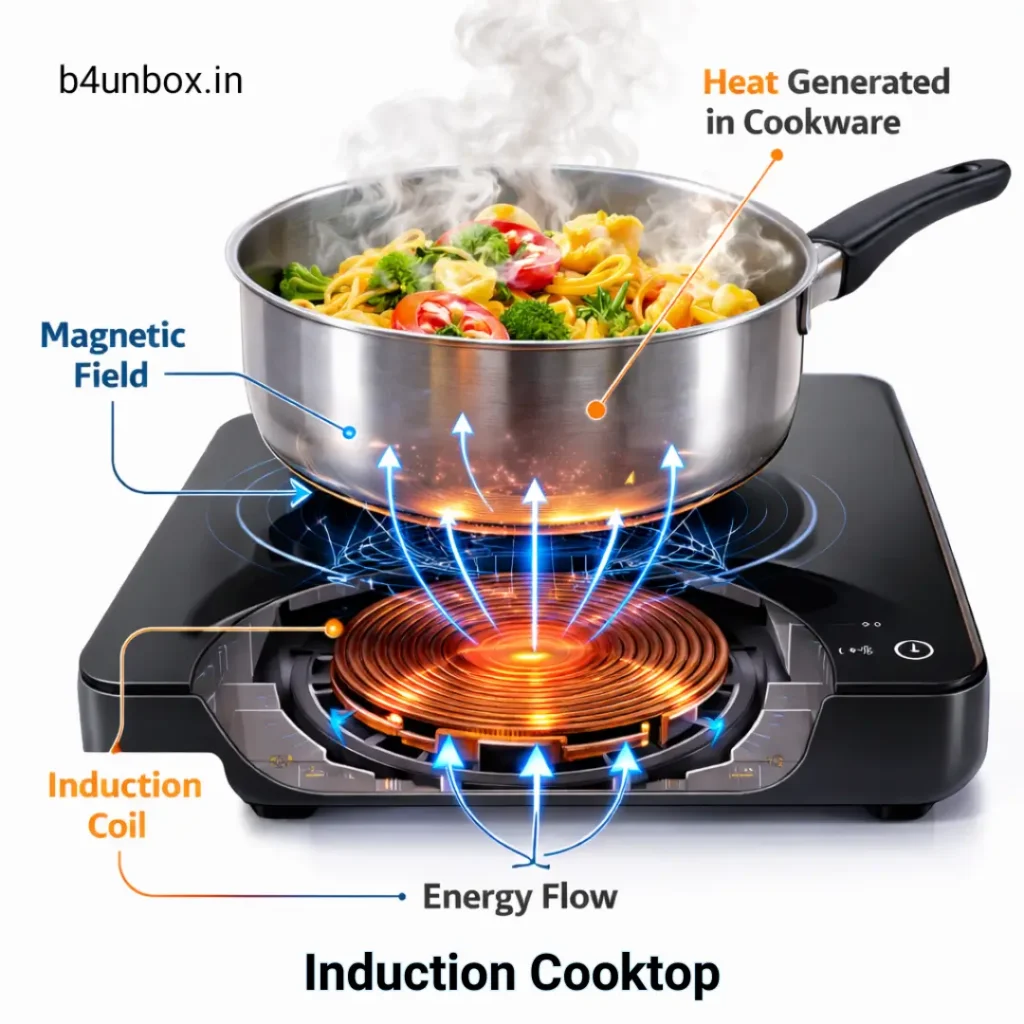
Induction cooking uses magnetic energy to generate heat directly inside the cookware.
Instead of heating the surface of the cooktop, this appliance generates a magnetic field; this field interacts with the metal base of the cookware. As a result of this interaction, heat is generated directly within the cookware itself.
Because the heat is generated directly in the cookware, cooking becomes faster and more efficient. In this process, the food heats up first, and subsequently, the cookware heats up due to the heated food.
Read Also: Prestige PIC 20 Induction Cooktop Review
Benefits of Induction Cooking
- Faster heating compared to most electric stoves
- Better energy efficiency
- More precise temperature control
- A cooktop surface that stays relatively cooler
However, induction cooking only works when the cookware has magnetic properties. Utensils made of aluminium, copper, or glass generally do not work unless they have a magnetic base.
This requirement is the main limitation users should understand before choosing induction cooking.
How Infrared Cooktops Work
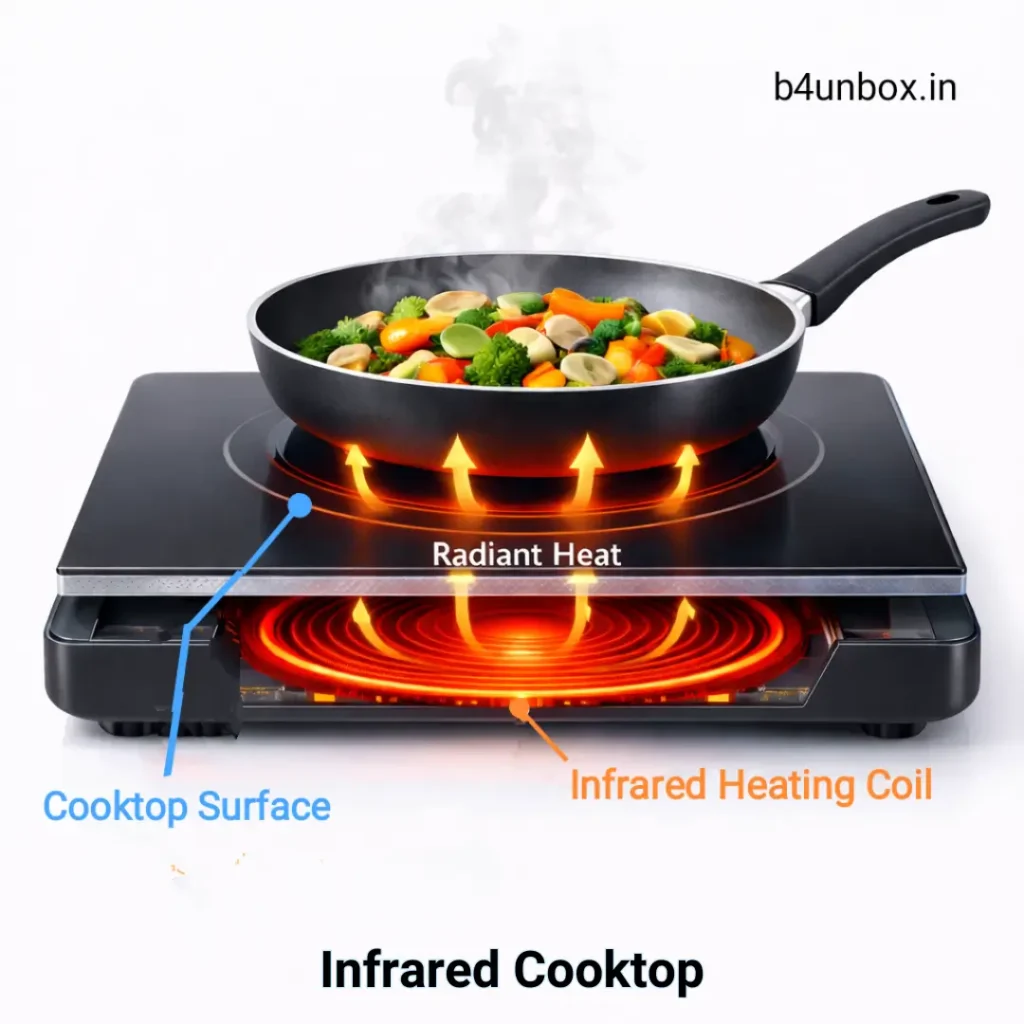
Infrared cooktops use a completely different approach.
Inside the appliance, there are heating elements that produce radiant heat. This heat first warms the glass surface of the cooktop. The heated surface then transfers heat to the cookware placed on top.
Here, the vessel heats up first, and then the food inside it begins to cook.
Because the heat travels through the surface before reaching the utensil, the process can take slightly longer compared to induction cooking.
Main Advantage of Infrared Cooktops
However, infrared cooktops have one major advantage: they work with almost any type of cookware.
You can use aluminium vessels, steel utensils, ceramic cookware, or even glass cookware in many cases.
For people who already have a large collection of traditional cookware, this compatibility can be convenient.
What Is the Difference Between Induction and Infrared Cooktop?
Induction cooktops use electromagnetic energy to heat the cookware directly. Infrared cooktops heat the glass surface first and then transfer that heat to the utensil. This is the biggest difference between induction and infrared cooktops.
Which Cooktop Supports All Utensils?
Infrared cooktops support almost all utensils including aluminium, copper, glass, ceramic, and steel. Induction cooktops only work with magnetic-base utensils like stainless steel and cast iron.
Which Cooktop Uses Less Electricity?
Induction cooktops usually use less electricity because they heat the utensil directly instead of heating the glass surface first. Infrared cooktops lose more heat through the surface, so electricity use is slightly higher.
Which Cooktop Is Better for Indian Cooking?
For Indian cooking, induction cooktops are better for fast boiling, pressure cooking, tea, frying, and daily cooking. Infrared cooktops are better if you use aluminium kadhais, glass cookware, clay pots, or traditional utensils.
Which Cooktop Is Safer for Families?
Induction cooktops are safer because the surface stays cooler and most models come with child lock, auto shut-off, and overheat protection. Infrared cooktops stay hot even after cooking, so there is more risk of burns.
Induction vs Infrared Cooktop for Small Family
For a small family, a 1600W induction cooktop is usually enough for daily cooking and uses less electricity. Infrared cooktops are better only if you want to continue using old aluminium or glass utensils.
The Right Way to Think About This Choice
Instead of asking “Which technology is better?” it helps to ask a different question:
Which technology suits your kitchen and cooking habits better?
If your goal is faster cooking and better energy efficiency, induction cooktops usually perform very well.
If your priority is utensil compatibility and flexibility, infrared cooktops may feel easier to use because you don’t need to change your cookware.
For many Indian households, induction cooktops often become the preferred option because they offer:
- Faster cooking speed
- Better temperature control
- Lower heat loss
- Easier cleaning
But that does not mean infrared cooktops are a bad choice. They simply serve a slightly different purpose.
Understanding this difference helps avoid unrealistic expectations.
Practical Advice Before Choosing
If you are planning to buy an electric cooktop for your kitchen, a few simple checks can make the decision easier.
Check your existing cookware.
If most of your utensils are magnetic stainless steel or cast iron, induction cooktops will work without problems.
Think about cooking speed.
People who cook frequently or want faster heating usually appreciate induction technology.
Consider electricity usage.
Induction cooking tends to be more energy efficient because heat is generated directly in the vessel.
Look at your cooking style.
For simple boiling, frying, or daily meals, both technologies can work well.
But for most Indian kitchens where speed and efficiency matter, induction cooktops often feel more practical.
Mistakes to Avoid
When choosing between induction and infrared cooktops, a few mistakes are common.
- Buying an induction cooktop without checking cookware compatibility
- Assuming infrared cooktops heat instantly
- Ignoring kitchen electricity conditions
- Choosing based only on price
Sometimes a slightly more expensive induction cooktop provides much better long-term efficiency.
Making an informed decision helps avoid these issues.
Conclusion
If you want faster cooking, lower electricity use, and better safety, induction cooktops are usually the better option. If you want support for all utensils, infrared cooktops are the better choice.
Induction and infrared cooktops may look similar on the outside, but they use very different heating technologies. Induction cooktops generate heat directly inside the cookware using magnetic energy, which makes cooking faster and more energy efficient. Infrared cooktops rely on radiant heat from heating elements, which makes them compatible with almost any type of utensil.
For many Indian households, induction cooktops are often the more practical choice because of their speed, efficiency, and easy cleaning.
However, the best option ultimately depends on your cookware, cooking habits, and kitchen setup.
Once you understand how each technology works, choosing the right cooktop becomes much simpler and far less confusing.
FAQs – Induction vs Infrared Cooktop
A: For most Indian homes, an induction cooktop is usually the better choice because it cooks faster, saves electricity, and offers better temperature control.
However, if you want to use any type of utensil without restrictions, an infrared cooktop can be more convenient.
A: No, not all utensils work on induction cooktops.Only cookware made of magnetic materials like cast iron or magnetic stainless steel works properly. Aluminium and glass utensils usually do not work unless they have an induction-compatible base. And a utensils with a flat bottom.
A: Flat-bottomed pots and utensils work best on induction cooktops because they make proper contact with the surface and allow efficient heating.
Deep-bottomed pots and utensils can also work, but only if their base is flat and made of magnetic material. If the bottom is curved or uneven, the cooktop may not detect it properly or heating may become inefficient.
A: Flat-bottomed pots and utensils are recommended for infrared cooktops because they allow better contact with the glass surface and more even heat transfer.
Deep-bottomed pots and utensils can also be used, as infrared cooktops support almost all types of cookware. However, if the base is uneven or not flat, heating may be slower and less efficient.
A: Infrared cooktops can consume slightly more electricity compared to induction cooktops.
This is because they first heat the glass surface and then transfer heat to the cookware, which leads to some heat loss.
A: Induction cooktops are generally considered safer because they heat only the cookware and not the entire surface.
Infrared cooktops can get very hot on the surface, so there is a higher chance of burns if touched accidentally.
A: Yes, for many people, induction cooktops can replace gas stoves for daily cooking.
They are especially useful during gas shortages, for small kitchens, or for students and working professionals.
A: This usually happens because the utensil is not magnetic.
Induction cooktops require a magnetic base to generate heat, so non-compatible utensils will not work.
A: Yes, infrared cooktops can be used for Indian cooking, especially for basic tasks like boiling, frying, and reheating.
However, they may feel slower compared to induction cooktops for high-heat cooking.
A: Induction cooktops heat faster because heat is generated directly inside the cookware.
Infrared cooktops take slightly more time since they first heat the glass surface.
A: Yes, you can use a pressure cooker on an induction cooktop if it has an induction-compatible base.
Most modern stainless steel pressure cookers support induction cooking.
A: Induction cooktops are more energy-efficient and help save electricity compared to infrared cooktops.
They transfer heat directly to the cookware with minimal energy loss.
A. Induction cooktops are better for faster cooking, lower electricity use, and better safety. Infrared cooktops are better if you want support for almost all utensils.
A. Infrared cooktops support almost all utensils including aluminium, copper, glass, ceramic, stainless steel, and cast iron cookware.
A. Yes, induction cooktops usually save more electricity because they heat the utensil directly instead of heating the glass surface first.
A. Normal aluminium utensils usually do not work on induction cooktops unless they have an induction-compatible magnetic base.
A. Induction cooktops are generally safer for elderly people because the surface stays cooler and most models come with auto shut-off and child lock features.
A. Induction cooktops are better for fast boiling, frying, pressure cooking, and daily Indian cooking. Infrared cooktops are better if you use aluminium or traditional utensils.
A. Induction cooktops heat faster because they transfer heat directly to the utensil.
A. Yes, infrared cooktops can usually work with glass utensils as long as the utensil has a flat bottom.
